Petty Cash Receipt Management: How Cash Expenses Are Tracked Without Losing Records
Learn how to manage petty cash receipts, document cash expenses, reconcile transactions, and organize business records with a simple digital receipt management system.
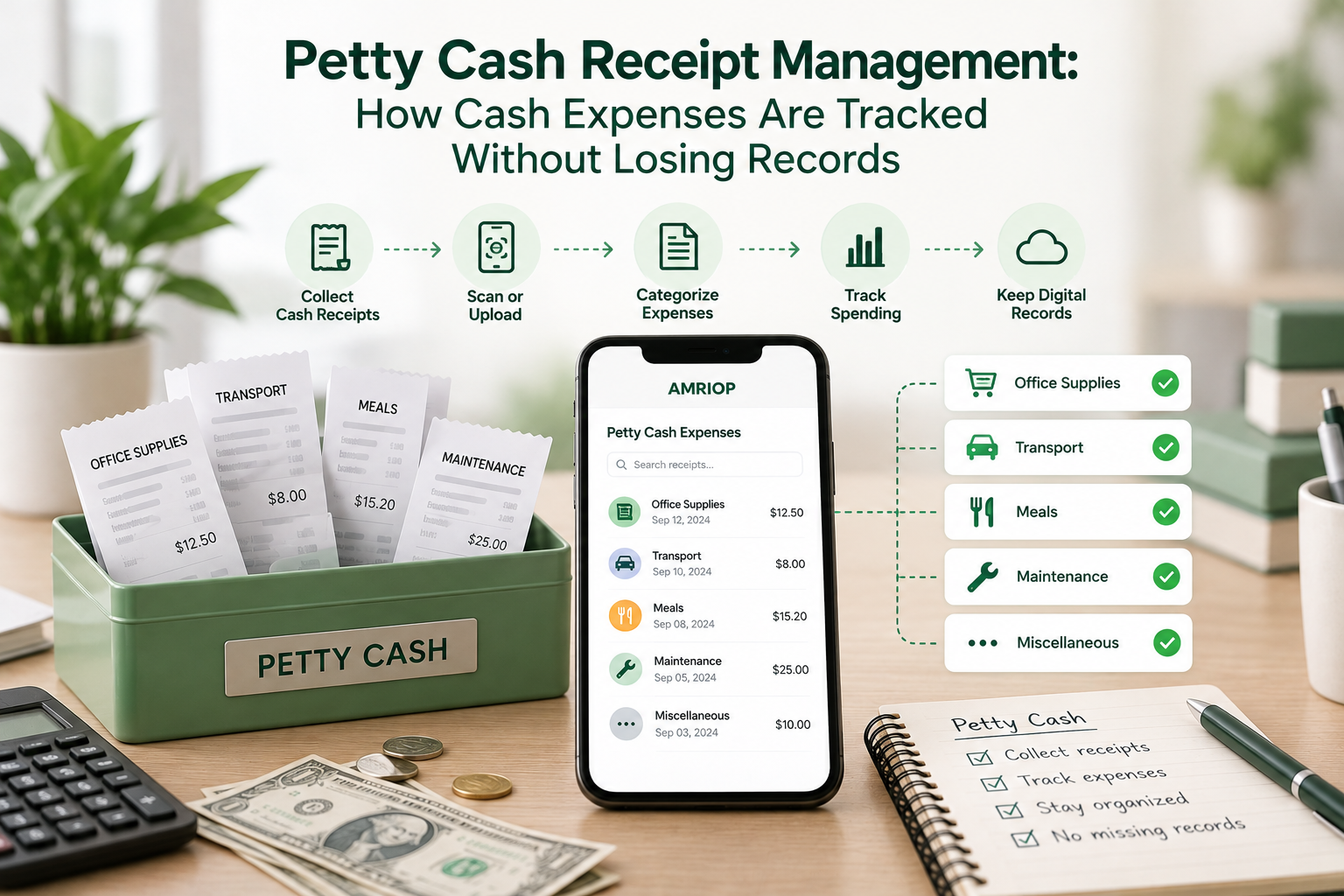
Cash expenses can disappear from a business's records when the receipts supporting them are treated as disposable. A structured petty cash receipt management process helps keep cash transactions documented, reconciled, and organized in digital receipt storage while supporting the business's broader recordkeeping system.
Petty cash is often used for small, routine business purchases that are inconvenient to pay by check or card. Office supplies, small maintenance items, local purchases, and other minor expenses may be paid from a cash fund.
The amount of each transaction may be small, but the documentation still matters. The IRS states that businesses need records that clearly and accurately reflect income and expenses, and supporting documents such as receipts, paid bills, invoices, and other records help substantiate transactions reported on a tax return.
A consistent petty cash receipt management system therefore helps separate cash from guesswork. Each payment can be recorded, supported by available documentation, reconciled against the fund, and preserved through digital receipt storage.
What Is Petty Cash Receipt Management, and Why Does It Consistently Fail?
Petty cash receipt management is the process used to document, organize, reconcile, and retain records of purchases made from a business's petty cash fund.
The IRS specifically recognizes petty cash slips as supporting documents for small cash payments. Its Publication 583 also describes a petty cash system in which a fixed fund is established and petty cash slips are attached to receipts as evidence of payments.
What Counts as a Petty Cash Expense?
A petty cash expense is generally a small business expense paid from a designated cash fund.
Examples may include:
- Office supplies
- Small maintenance purchases
- Minor equipment or operating items
- Small local vendor payments
- Delivery or service-related expenses where cash is accepted
- Other low-value business expenses permitted under the company's internal policy
There is no universal federal rule that defines one dollar amount as "petty cash." Each business can establish its own fund amount, approval process, and spending limits according to its operational needs.
The important distinction is that a payment being made in cash does not eliminate the need for a business record. Supporting documents should identify relevant details such as the amount, payee, date, and business purpose of the expense.
Why Cash Receipts Are Lost More Often Than Digital Ones
Card and electronic payments generally create additional transaction records through financial institutions. Cash purchases do not automatically create the same type of electronic trail.
That makes the receipt and related documentation particularly important.
A cash transaction can become difficult to reconstruct when:
- The receipt is misplaced.
- The paper fades or becomes damaged.
- Several employees use the same fund.
- The purchase is recorded days later.
- The business cannot determine who made the payment.
- The business purpose is not documented.
A consistent receipt tracker can reduce these gaps by connecting each cash payment with its supporting documentation.
Petty cash receipt management becomes difficult when cash purchases are treated informally and receipt collection depends on individual memory. A structured process creates a record for each transaction and makes reconciliation easier.
What Information Should Be Recorded for Every Petty Cash Transaction?
The exact documentation required can depend on the nature of the expense and the business's recordkeeping and tax obligations. For a practical internal system, the following information provides a useful starting point.
| Information | Why It Matters |
| Date of purchase | Connects the expense to the correct accounting period |
| Vendor or payee | Identifies who received the payment |
| Item or service | Shows what was purchased |
| Amount paid | Allows the cash fund to be reconciled |
| Payment method | Confirms that the transaction was paid from petty cash |
| Business purpose | Helps establish why the expense was incurred |
| Person making the purchase | Creates an internal responsibility trail |
| Approval, where required | Supports the company's internal control process |
| Receipt or supporting document | Provides documentary evidence of the transaction |
The IRS explains that supporting documents for business expenses should show information such as the payee, amount paid, proof of payment, date incurred, and description of the item or service. In some situations, a combination of documents may be needed to substantiate the complete expense.
What Should Be Done When a Vendor Does Not Give a Receipt?
A missing vendor receipt should not simply be ignored.
The transaction can be documented as close to the time of payment as possible. An internal petty cash voucher can record the date, payee, amount, item or service, business purpose, and person responsible for the purchase.
Other available supporting evidence can also be retained, such as:
- An invoice
- A payment confirmation
- A vendor statement
- A purchase order
- An internal authorization
- A contemporaneous written explanation
- Other evidence connected to the transaction
The IRS states that if a receipt cannot be obtained for a cash payment, an adequate explanation should be included in the business's records at the time of payment.
An internal voucher should therefore be treated as supporting documentation, not automatically described as a legally equivalent replacement for every missing vendor receipt.
The documentation should provide enough information to help the business establish what happened and why the expense was incurred.
Date, payee, amount, item or service, payment information, and business purpose create a useful petty cash record. When an original receipt is unavailable, an internal voucher and other available evidence can help document the transaction, but the appropriate documentation depends on the circumstances.
How Is a Petty Cash Receipt Management System Set Up Step by Step?
A simple process can be established without turning petty cash into a complicated accounting exercise.
Step 1: A Fixed Petty Cash Fund Is Established
A business can establish a fixed petty cash amount based on its normal operating needs.
For example, a business may decide to maintain a $100 petty cash fund. The amount itself is a business decision, not a universal federal requirement.
The important principle is consistency.
The cash held plus the documented outstanding expenses should reconcile to the established fund amount.
The IRS's example of a petty cash system uses a fixed fund and reconciles the remaining cash with petty cash slips before the fund is replenished.
Step 2: A Receipt Capture Habit Is Standardized
Every person using the fund should follow the same procedure.
When a purchase is made:
- Obtain the vendor receipt whenever one is available.
- Record the transaction details.
- Capture a clear receipt scan or photograph.
- Keep the physical receipt in the designated location.
- Upload the digital copy to the company's receipt management system.
Capturing the receipt close to the time of purchase also improves the accuracy of the associated record. The IRS notes that timely records generally have greater value than statements prepared later when accurate recall may be difficult.
How to Keep Track of Receipts Without Losing Them
Step 3: A Petty Cash Log Is Maintained Alongside the Receipts
Each transaction should have a corresponding entry in the petty cash log.
A basic log may contain:
Date | Vendor | Amount | Category | Employee | Receipt Reference | Business Purpose
The receipt and log should remain connected through a reference number or another consistent identifier.
This prevents a situation in which the cash balance appears correct but the supporting documentation cannot be located.
Step 4: Reconciliation Is Performed Regularly
Petty cash should be reconciled according to a schedule appropriate to the volume and risk of transactions.
Weekly reconciliation can be practical for businesses with frequent petty cash activity. A smaller fund with very limited activity may use a different schedule under its internal controls.
The basic reconciliation principle is:
Cash remaining + documented petty cash slips/expenses = established petty cash fund
If the numbers do not agree, the discrepancy should be investigated before the next replenishment whenever practical.
Step 5: Receipts Are Digitized and Organized
A clear digital receipt storage process can be used to preserve the supporting documents.
The receipt scan should be checked for readability before the physical document is discarded or archived according to the company's retention policy.
Digital records can be organized by:
- Year
- Month
- Expense category
- Vendor
- Employee
- Receipt reference number
Electronic records can be used for business recordkeeping, but the IRS states that electronic systems must provide a complete and accurate record of the data and that electronic records are subject to the applicable recordkeeping requirements.
Five practical steps, fixed fund, standardized capture, transaction logging, regular reconciliation, and digital archiving, create a structured petty cash receipt management process.
What Is the Difference Between Petty Cash Receipts and Regular Business Receipts?
The main difference is the payment method and the surrounding documentation.
| Aspect | Petty Cash Receipts | Other Business Receipts |
| Typical payment method | Cash | Card, check, electronic transfer, or other methods |
| Automatic financial record | Usually limited | May include bank or card records |
| Supporting receipt | Important | Important where applicable |
| Reconciliation | Against petty cash fund | Against bank, card, or accounting records |
| Internal control | Often requires cash authorization | Usually relies on account/payment controls |
| Tracking tool | Receipt tracker and petty cash log | Accounting or receipt management system |
| Risk of missing documentation | Higher if cash is handled informally | Additional transaction records may exist |
A bank or card record can provide evidence that a payment occurred, but it may not contain every detail needed to establish the business purpose or nature of the expense. The IRS notes that supporting documentation may need to establish multiple elements of a transaction.
Petty cash requires particular attention because the payment itself may not create the same automatic financial record as a card or bank transaction.
Which Mistakes Cause Petty Cash Receipt Management to Break Down?
Several simple mistakes can weaken an otherwise useful petty cash system.
Replenishing the Fund Before Reconciliation
If the fund is replenished before outstanding transactions are reviewed, discrepancies can become harder to trace.
Keeping Receipts in a Shared Drawer
A common drawer may become a mixture of receipts, notes, and unrelated papers. A receipt can disappear before it is recorded.
Relying on Verbal Authorization
Internal controls are stronger when approvals and business purposes are documented rather than relying entirely on memory or verbal instructions.
Mixing Personal and Business Purchases
Personal purchases should not be casually mixed with business petty cash. Business and personal transactions should be kept separate in accordance with the business's accounting procedures.
Delaying Receipt Scanning
A receipt that remains in someone's wallet or vehicle for several weeks has a higher chance of being lost or damaged.
Same-day capture creates a stronger documentation habit.
Petty cash receipt management commonly breaks down when reconciliation is delayed and receipt capture depends on individual memory instead of a standardized process.
How Is a Receipt Management App Used to Modernize the Petty Cash Process?
A receipt management app can provide a digital layer around an existing petty cash process.
Instead of relying exclusively on paper envelopes and handwritten records, receipts can be captured and organized digitally.
Depending on the features of the software, the workflow may include:
Receipt Scan at the Point of Purchase
A phone camera can be used to create a digital copy of the receipt immediately after purchase.
Automated Data Extraction
Some receipt management software uses OCR or other extraction technology to identify information such as vendor, date, and amount. Extracted information should still be reviewed for accuracy rather than assumed to be correct.
Searchable Digital Receipt Storage
Receipts can be organized and searched using available fields such as vendor, date, amount, or category.
Digital Backup
Cloud-based storage can reduce dependence on a physical envelope or filing cabinet. However, businesses should review the service's retention, export, security, and backup capabilities rather than assuming that every digital service provides the same protections.
Easier Record Retrieval
When a transaction needs to be reviewed, a searchable receipt management system can make the supporting document easier to locate.
A digital tool does not replace accounting controls or determine whether an expense qualifies for a tax deduction. Instead, it can make the underlying documentation easier to capture, organize, and retrieve.
A receipt management app can convert a paper-heavy petty cash process into a searchable digital record, while the business's accounting and documentation procedures remain responsible for determining how each transaction is recorded and supported.
Frequently Asked Questions
Are petty cash receipts required for U.S. tax recordkeeping?
Not every petty cash transaction is governed by one universal federal receipt format. The IRS requires businesses to maintain records that clearly and accurately reflect income and expenses and to retain sufficient supporting documentation to substantiate applicable expenses. Receipts are one type of supporting document, but the documentation required can depend on the transaction.
For specific tax situations, especially expenses subject to additional substantiation rules, professional tax advice should be obtained.
How long should petty cash receipts be kept?
For many federal tax records, three years is a common period, but the required retention period depends on the record and circumstances. Some records may need to be retained longer, including certain employment-tax and asset-related records.
Businesses should therefore establish a retention policy based on their tax, accounting, legal, contractual, and operational requirements.
What should be done if a petty cash receipt is lost after the purchase?
The transaction should be documented as soon as the missing receipt is identified.
An internal record can describe the date, payee, amount, item or service purchased, business purpose, and circumstances surrounding the missing receipt. Other available supporting evidence should also be retained.
The IRS advises that when a receipt cannot be obtained for a cash payment, an adequate explanation should be made in the records at the time of payment.
A missing receipt should not automatically be assumed to be deductible simply because an internal voucher was created.
Can petty cash expenses be claimed as business tax deductions?
Potentially, if the expense qualifies under applicable tax rules and is adequately documented and substantiated. The fact that an expense was paid from petty cash does not by itself make it deductible.
The IRS states that businesses must be able to substantiate expenses claimed on tax returns and maintain records supporting those claims.
Tax treatment can depend on the type of expense and the business's circumstances, so a qualified tax professional should be consulted for specific tax advice.
What is the difference between a petty cash receipt and a petty cash voucher?
A petty cash receipt is generally a vendor-issued document showing a purchase or payment.
A petty cash voucher is an internal business document used to record and authorize a cash disbursement. It can contain information such as the date, amount, payee, business purpose, purchaser, and approval.
They serve different purposes. A voucher can supplement the available documentation, particularly when an original receipt is unavailable, but it should not automatically be treated as a universal legal substitute for a vendor-issued receipt.
Disclaimer: The views and opinions expressed in this blog are those of the blogger and are provided for informational purposes only. They should not be considered legal advice or a substitute for advice from a qualified legal professional.
Related Blogs
View all the related blogs from here
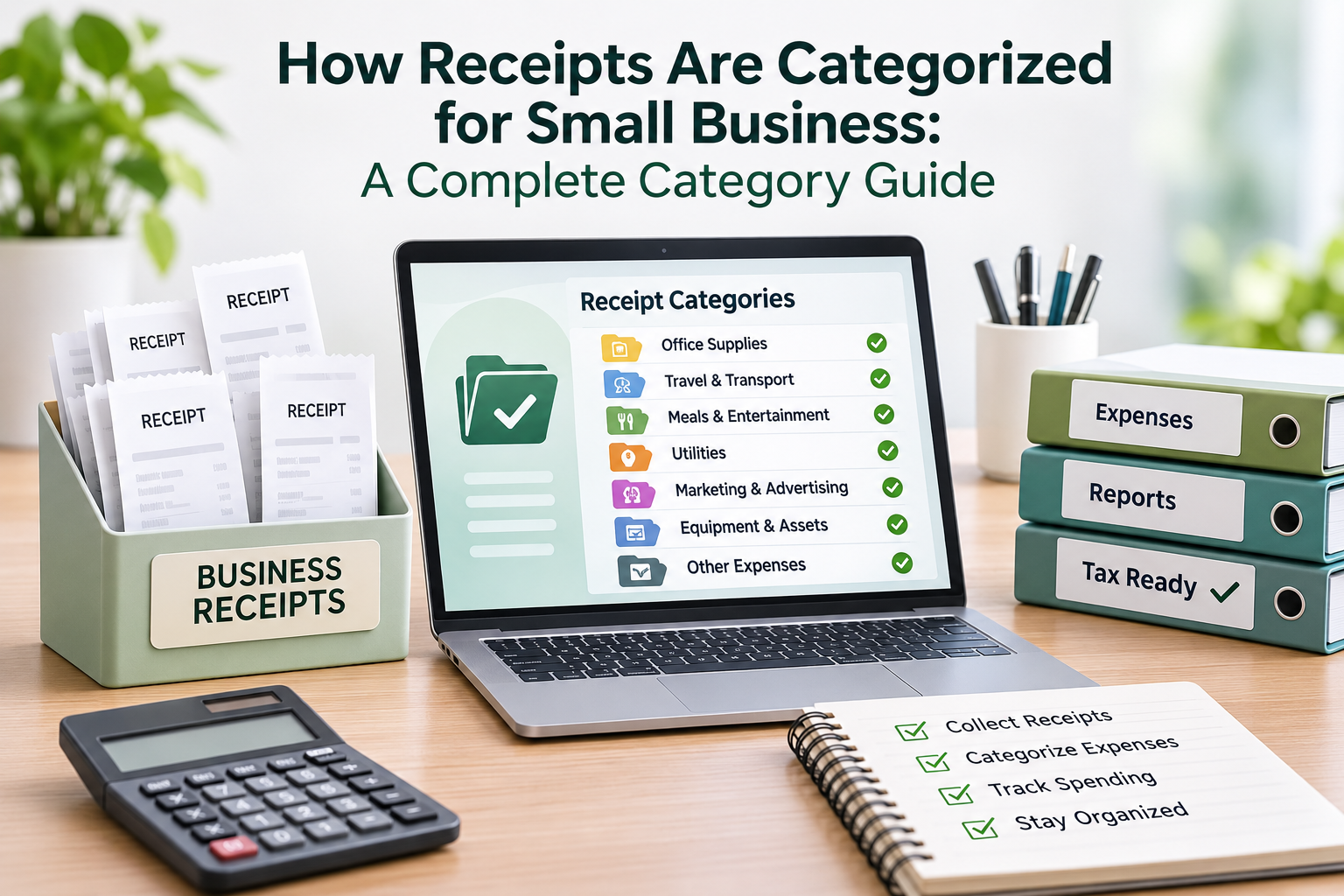
How Receipts Are Categorized for Small Business: A Complete Category...
Learn how to categorize small business receipts, standardize expense categories, organize financial records, and simplify reconciliation with a consistent recei...
 Uploaded on 25 Oct 2026

How to Manage Online Shopping Receipts Across Amazon and Multiple...
Manage online shopping receipts from Amazon, Flipkart, and other platforms. Learn how to organize digital invoices, automate email sorting, and store purchase r...
Uploaded on 25 Oct 2026

How a Receipt Management App Is Used for Personal Budgeting...
Learn how to use a receipt management app for personal budgeting, including organizing receipts, tracking household spending, and managing digital purchase reco...
Uploaded on 04 Oct 2026
Start Your Paperless Journey
At Amriop, we’re more than an invoice management software, we’re building a smarter, more sustainable way to handle digital receipts. Whether you want to manage eReceipts more efficiently, adopt electronic receipts to reduce waste, or use secure digital receipt storage, Amriop offers a receipt organizer and receipt management system designed for everyone.
Go Paperless Now